
Swar Vigyan
Swar Vigyan (Sanskrit: स्वर विज्ञान) is an ancient spiritual science rooted in the observation and application of breath. It goes beyond the physical process of inhalation and exhalation to reveal deep insights into energy, health, emotions, karma, and spiritual growth. Swar Vigyan teaches that the breath flowing through either nostril at any given time is not random but has profound implications. It guides our actions, thoughts, success, and even our health. By understanding and harmonizing with these breath patterns, one can live in greater alignment with the cosmic rhythm and attain mastery over the inner and outer life.
Panch Tatva

The human body and the universe are composed of five basic elements: Earth (Prithvi), Water (Jal), Fire (Agni), Air (Vayu), and Space (Akash). These Panch Tatvas are in constant interaction with our breath. Each swar (breath through a particular nostril) activates specific elements. The left nostril, governed by the Ida Nadi, enhances the Earth and Water elements, bringing calmness, receptivity, and grounding. The right nostril, governed by the Pingala Nadi, activates Fire and Air, enhancing action, digestion, and alertness. When both nostrils are active, it indicates the awakening of the Space element and activation of Sushumna Nadi, supporting spiritual experiences and neutral states of consciousness. Swar Vigyan helps balance these elements within, ensuring harmony in the body and mind.
Panch Kosh
In the yogic tradition, the human existence is not limited to the body alone but extends through five sheaths or koshas: Annamaya (physical body), Pranamaya (energy body), Manomaya (mental body), Vigyanmaya (intellect body), and Anandamaya (bliss body). Swar Vigyan influences all five koshas. The breath supplies energy to the Annamaya Kosh and governs the Pranamaya Kosh directly. With refined swar practice, mental clarity is enhanced in the Manomaya Kosh, wisdom arises in the Vigyanmaya Kosh, and the seeker touches bliss in the Anandamaya Kosh. Thus, proper swar awareness is a multidimensional tool for spiritual and physiological evolution.

Pranayam aur Swar Sadhana

While both Pranayam and Swar Sadhana work with breath, they differ in methodology and intent. Pranayam focuses on the conscious regulation of breath through specific ratios, techniques, and holds to control prana (life-force). It is often used to prepare the mind for meditation and improve health. Swar Sadhana, on the other hand, is based on observation rather than manipulation. It teaches one to live in tune with the natural breath cycle and use the dominant nostril at the right time for specific actions. Pranayam trains the breath, whereas Swar Sadhana follows its divine intelligence.
Swas and Praan
In the subtle sciences of India, ‘swas’ refers to the breath and ‘praan’ refers to the life-energy that rides upon it. The breath is the medium, and the praan is the force that animates life. Every breath we take affects the distribution and quality of praan in the body. If the breath is disturbed, irregular, or flows through the wrong nostril at inappropriate times, it weakens the pranic flow and can lead to diseases. A regulated and harmonized breath, aligned with Swar Vigyan, strengthens the praan, supporting healing, clarity, and vitality.
Nadiyan aur Panch Praan
The human energy system is sustained by five primary forms of vital energy known as the Panch Praan: Prana, Apana, Samana, Udana, and Vyana. Each of these praanas governs a specific region and function in the body. Prana governs the chest and is responsible for breathing and heart functions. Apana governs the lower abdomen and manages elimination and reproductive processes. Samana is centered in the navel region and manages digestion and assimilation. Udana is located in the throat and head and governs speech, memory, and upward movement of energy. Vyana pervades the entire body and manages circulation and coordinated movement. Swar Vigyan helps balance these five praanas by aligning the breath flow, ensuring smooth and harmonious energy distribution in the body.
“Praan Sadhana is the yogic discipline of cultivating and strengthening life-force.” This is done not by controlling the breath but by becoming intensely aware of it and using it to direct energy consciously. Through Swar-based meditation, mantra recitation in the correct swar, and inner silence, a practitioner refines the quality of their praan. As praan becomes purified, it enhances vitality, increases awareness, and leads to deep spiritual transformation.

Shubh-Ashubh Swar
The science of Swar identifies the breath through the left and right nostrils as shubh (auspicious) or ashubh (inauspicious) depending on the activity and time. Left nostril dominance is auspicious for mental work, spiritual practice, and feminine tasks. Right nostril is auspicious for physical effort, business, confrontation, and masculine roles. Choosing to act based on the right swar improves outcomes. Ignoring swar often results in unnecessary obstacles and failures.
Vipreet Swar
Vipreet swar refers to the nostril being active in contradiction to the activity being performed. For example, undertaking a journey or initiating a major project when the left swar is dominant can bring delays, confusion, or failure. Similarly, meditating or chanting during right swar may increase restlessness. Swar Vigyan helps identify such misalignments and teaches remedies or adjustments to bring the body and environment into balance.
Nadiyan aur Kundalini
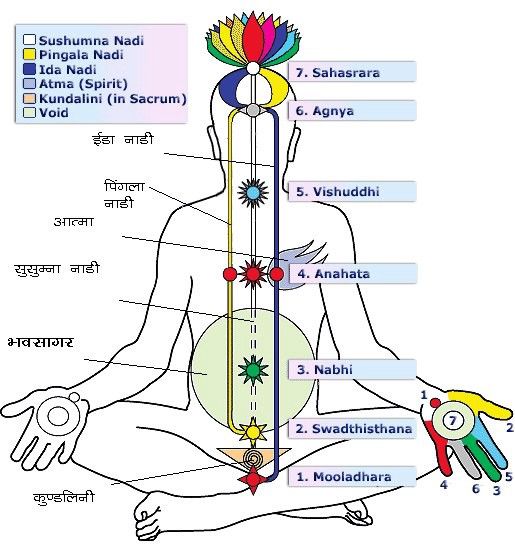
Breath flows through thousands of nadis, or energy channels, in the subtle body. The three most important are Ida (left), Pingala (right), and Sushumna (central). These nadis support the function of the five vital praanas: Prana (chest and respiration), Apana (lower body and excretion), Samana (digestion and assimilation), Udana (speech and memory), and Vyana (circulation and movement). Swar Vigyan enables one to balance and energize these praanas by choosing activities according to the active nostril and maintaining energy flow in the proper channels.
When the Ida and Pingala nadis become balanced through Swar Sadhana, the central Sushumna Nadi becomes active. This is essential for the awakening of Kundalini Shakti—the dormant spiritual energy at the base of the spine. Kundalini cannot rise through impure or blocked nadis. By mastering Swar Vigyan, one ensures that the nadis are clear and the swar is harmonized, creating the right inner conditions for Kundalini to ascend through the chakras safely and steadily.
Applications of Swar Vigyan
Swar Healing
Swar Vigyan offers a breath-based approach to healing. Many health issues arise due to prolonged imbalance in swar. Breathing primarily through the right nostril can cause overheating, high blood pressure, or aggression, while left nostril dominance may lead to coldness, depression, or fatigue. Through conscious swar adjustment and practice, many of these conditions can be improved. Breathing through a specific nostril at specific times aids digestion, sleep, immunity, and emotional balance.
Swar and Fasting
When practicing fasting, Swar Vigyan plays a supportive role in sustaining energy and detoxifying the system. During fasts, awareness of the active swar allows the body to draw praan more efficiently from the environment, reducing dependency on food. Swar Sadhana can help manage hunger, maintain mental focus, and enhance the body's self-healing capacity during fasts.
Sparsh Chikitsa (Reiki)
When the breath is pure and praan is strong, even touch becomes a powerful healing force. Sparsh Chikitsa, or touch therapy based on Swar Vigyan, involves using the dominant swar hand to transmit praan into others or oneself. For instance, during right swar, using the right hand for energizing or healing enhances effect, and during left swar, the left hand works better. This subtle but effective technique can be used for pain relief, emotional support, and energy rebalancing.
Marjan
Marjan is an energetic cleansing practice that purifies the subtle body through breath and intention. Using Swar Vigyan, one can perform specific techniques to cleanse the aura, remove psychic impurities, and expel negative influences. This is often combined with mantras or visualization and done at sunrise or specific transitions in swar. Daily Marjan promotes clarity, spiritual protection, and emotional balance.
Mantrakshar
Each Sanskrit syllable or akshar is connected to specific energy vibrations and swar patterns. Chanting mantras with the correct swar enhances their potency significantly. For example, chanting a bija mantra during the corresponding active nostril opens specific chakras and activates inner energies. This combination of breath and sound is foundational in mantra siddhi, where a mantra becomes spiritually empowered.
Tatva Upchar
Tatva Upchar is healing through elemental balance using Swar Vigyan. By identifying which element is deficient or excessive through swar observation, one can apply therapies using food, colors, mantras, rituals, and nostril-specific breathing. For example, Agni (fire) can be strengthened through right swar activities and sun exposure, while Jal (water) can be increased through moon practices and left swar activation.
Swar aur Jyotish

Swar Vigyan and Jyotish Shastra (Vedic Astrology) are closely linked. While astrology reveals long-term planetary influences, Swar reveals real-time energetic conditions. A trained Swar practitioner can assess the suitability of an action more precisely than a chart by checking the swar at the time. For instance, the swar active when one wakes up can indicate the tone of the day or predict results of specific undertakings.
Swar aur Bhavishya Darshan
With refined Swar awareness, a practitioner gains the ability to intuit future events. This includes subtle predictions based on breath flow, timing, and energetic impressions. By observing the swar at key life moments—during thoughts, decisions, or meetings—one can foresee obstacles or advantages. This art of inner forecasting is a direct experience and needs sensitivity more than logic.

Mrityu aur Usse Bachav

In the final stages of life, the swar often becomes erratic or ceases. Advanced yogis monitor swar patterns to detect critical health deterioration. There are documented cases where correct swar regulation and practice of certain kriyas have revived patients or prolonged life. Understanding swar in the context of death offers tools for both prevention and peaceful departure.
Swar Vigyan
( Advance Course )
( By Yog Guru Shree Ashish Yogi Ji )
We offer guided LIVE Swar Vigyan sessions, personalized coaching, and a complete Swar Vigyan Course to help you accelerate your journey safely and effectively.
